10 Digital Skills Every Ghanaian Student Should Learn
10 Digital Skills Every Ghanaian Student Should Learn

10 Digital Skills Every Ghanaian Student Should Learn.
Discover 10 practical digital skills Ghanaian students can learn before graduation to improve their academic performance, employability, and career opportunities.
Technology has become an important part of education and the modern workplace. For students in Ghana, having a university or college qualification is valuable, but combining academic knowledge with practical digital skills can create additional opportunities.
Many employers now expect graduates to be comfortable using digital tools, communicating online, researching information, and adapting to new technologies. Students who begin developing these skills before graduation can enter the job market with greater confidence.
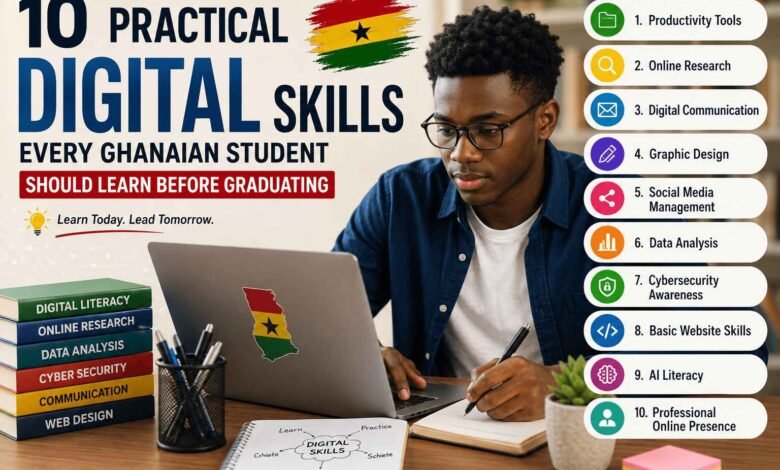
Here are ten practical digital skills worth developing.
1. Microsoft Office and Productivity Tools
Students should be comfortable using basic productivity applications such as word processors, spreadsheets, and presentation software.
These tools are useful for:
- Writing reports and assignments.
- Creating presentations.
- Organizing information.
- Managing budgets.
- Analyzing simple data.
- Preparing professional documents.
Knowing how to format a professional document or create a basic spreadsheet can be useful in almost every workplace.
2. Online Research
The internet provides access to enormous amounts of information, but students need to know how to identify reliable sources.
Good research habits include checking who published information, comparing multiple sources, examining publication dates, and distinguishing facts from opinions.
Students should also learn how to properly reference sources when preparing academic work.
3. Digital Communication
Email, messaging platforms, video meetings, and collaborative tools are now common in education and employment.
Students should learn how to write professional emails, participate appropriately in online meetings, and communicate clearly with lecturers, employers, colleagues, and clients.
Good digital communication can make a strong first impression.
4. Basic Graphic Design
Graphic design is no longer limited to professional designers. Students can learn basic design principles using accessible online tools.
These skills can be useful for creating:
- Social media graphics.
- Presentations.
- Posters.
- Event flyers.
- Personal portfolios.
- Small-business promotional materials.
Students studying communication, marketing, business, media, and related fields may find these skills particularly valuable.
5. Social Media Management
Social media is an important communication and marketing tool for businesses and organizations.
Students who understand how social platforms work can learn how to create content, manage pages, communicate with audiences, and analyze basic engagement statistics.
This can also become a freelance skill for students interested in helping small businesses manage their online presence.
6. Basic Data Analysis
Data is used in almost every industry. Students do not necessarily need to become professional data scientists, but understanding basic data analysis can provide a significant advantage.
Learning how to organize information in spreadsheets, use formulas, create simple charts, and interpret basic statistics can help students make better decisions.
These skills are particularly useful in business, finance, science, education, and administration.
7. Cybersecurity Awareness
Every internet user should understand basic cybersecurity.
Students should know how to create strong passwords, recognize suspicious messages, protect personal information, and use two-factor authentication where available.
Understanding online safety can help protect academic accounts, email addresses, social media profiles, and personal data.
8. Basic Website Skills
Having a basic understanding of how websites work can benefit students in many careers.
Students can start by learning concepts such as:
- HTML and CSS.
- Website structure.
- Content management systems.
- Basic search engine optimization.
- Domain names and web hosting.
Even students who do not plan to become programmers can benefit from understanding how websites and digital platforms operate.
9. Artificial Intelligence Literacy
Artificial intelligence is becoming increasingly important across education and employment.
Students should learn how AI tools work, what their limitations are, and how to use them responsibly.
AI can assist with tasks such as brainstorming, research planning, summarizing information, and improving productivity. However, students should verify information produced by AI and follow their school’s academic integrity rules.
The ability to work alongside new technology may become increasingly important as workplaces evolve.
10. Building a Professional Online Presence
Students can begin building their professional identity before graduation.
A professional online presence might include:
- A well-written LinkedIn profile.
- An online portfolio.
- A professional email address.
- Examples of completed projects.
- Relevant certificates and achievements.
Students should also review their public social media profiles and consider how their online activity could be perceived by potential employers.
Why These Skills Matter
Academic qualifications provide important knowledge, but practical skills can help students demonstrate what they are capable of doing.
A student who can communicate professionally, analyze information, create digital content, use productivity software, and adapt to new technology may have more opportunities when applying for internships, jobs, freelance work, or entrepreneurial opportunities.
The good news is that many digital skills can be learned gradually through free or affordable online resources.
Start Small and Keep Practicing
Students don’t need to master every skill immediately.
A better approach is to choose one area, practice regularly, complete small projects, and gradually build a portfolio of work.
For example, a student interested in marketing could begin by creating a mock social media campaign. Someone interested in data could analyze a small dataset using a spreadsheet. An aspiring web developer could build a simple personal website.
Practical projects turn theoretical knowledge into demonstrable skills.
Digital skills are becoming increasingly important for students preparing for the modern workplace. From productivity software and online research to cybersecurity, data analysis, artificial intelligence, and professional communication, these abilities can complement academic qualifications and open new opportunities.
For Ghanaian students, developing these skills before graduation can provide a valuable head start in a competitive employment environment.
The most important step is simply to begin. Choose one skill, practice consistently, and use what you learn to create something useful.
FOLLOW US ON FACEBOOK