Ghana Card Enforcement Begins November 2: What Ghanaians Must Know
Ghana Card Enforcement Begins November 2: What Ghanaians Must Know


Ghana Card Enforcement Begins November 2: What Citizens, Banks and Businesses Need to Know
Ghana is entering an important phase in the implementation of its national identity verification system, as the National Identification Authority (NIA) prepares to intensify nationwide enforcement of regulations governing the use of the Ghana Card from November 2, 2026.
The enforcement exercise is expected to affect businesses, financial institutions, government agencies and other organisations that rely on the Ghana Card to establish the identity of customers, clients and members of the public.
At the centre of the new measures is a requirement for institutions to move away from relying on visual inspection, photocopying, scanning or retaining copies of the Ghana Card for identity verification purposes, except where permitted by law.
The changes are backed by the National Identity Register (Amendment) Regulations, 2026, known as Legislative Instrument 2523 (L.I. 2523).
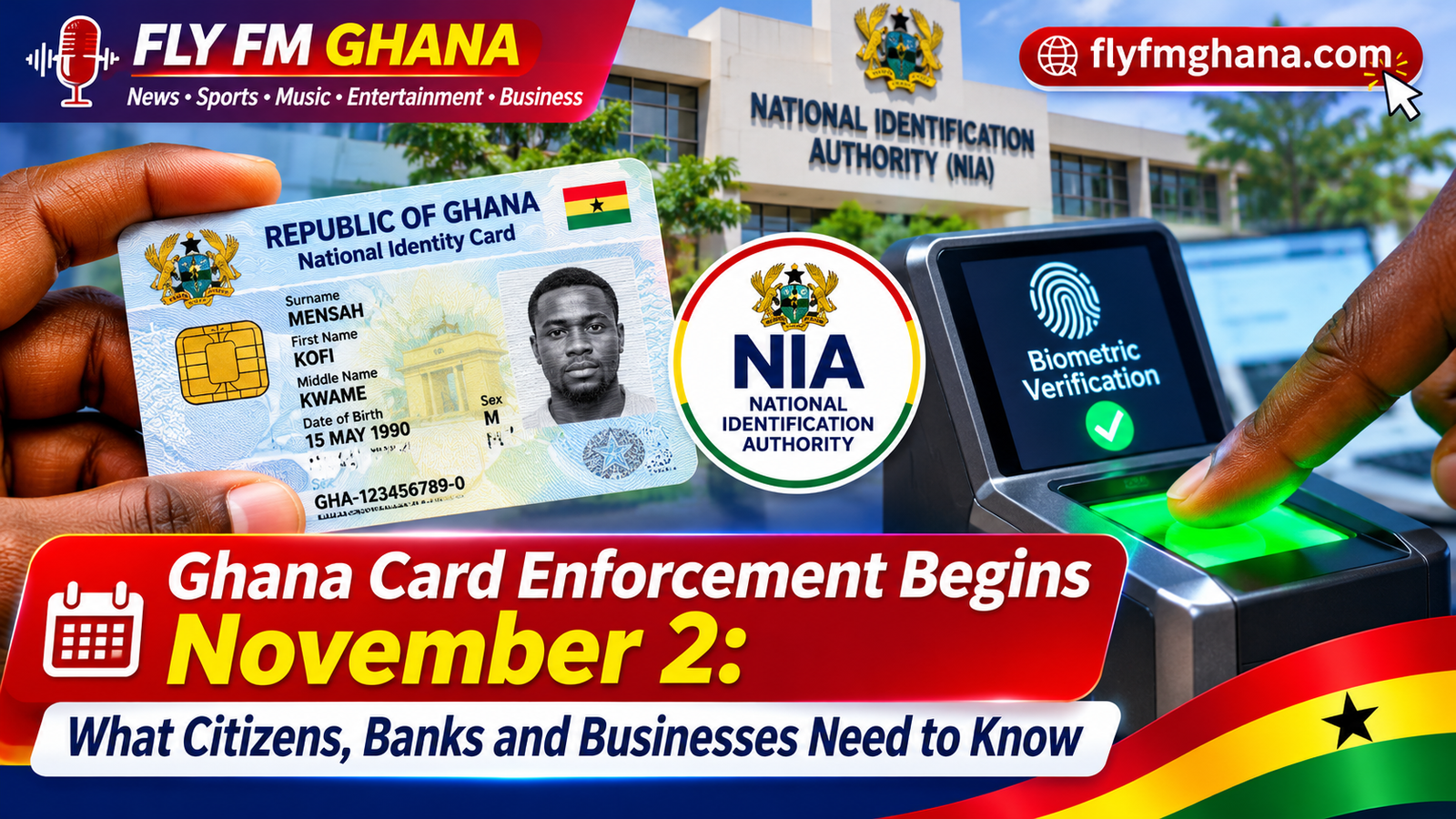
The National Identification Authority says the regulations are designed to strengthen identity protection, improve the security of personal information and reduce opportunities for identity fraud.
For ordinary Ghanaians, the development raises important questions. Will people still need to carry their physical Ghana Cards? Can banks continue photocopying identity cards? What happens when a business requests a copy of a customer’s Ghana card? And how will organisations verify customers under the new system?
Here is what citizens, businesses and institutions need to understand as the nationwide enforcement phase approaches.
What Is Happening on November 2?
The National Identification Authority is moving into a stronger enforcement phase concerning compliance with the new Ghana Card verification requirements.
According to a November 1 report by Graphic Online, the NIA has activated its Biometric Verification Taskforce to begin nationwide enforcement on November 2, 2026.
The taskforce is expected to focus on institutions that continue to rely on prohibited identity verification practices, particularly the photocopying and visual inspection of Ghana Cards.
The development follows the introduction of L.I. 2523, which established a more secure approach to identity verification using biometric information held by the National Identification Authority.
The NIA announced in July 2026 that the regulations had already come into force on June 9, 2026. The November 2 date therefore represents an intensified nationwide enforcement phase rather than the original commencement of the regulations.
This distinction is important because businesses and institutions should not assume that the requirements only become applicable from November 2.
Organisations that handle identity information are expected to understand their responsibilities and take the necessary steps to comply with the regulations.
What Is L.I. 2523?
L.I. 2523 is the National Identity Register (Amendment) Regulations, 2026.
It introduces changes to the way organisations are expected to verify the identity of Ghana Card holders.
Under the new arrangements, identity verification should be conducted through the NIA’s authorised biometric verification system rather than relying solely on a physical examination or photocopy of the card.
The regulations were signed by the Minister responsible for the National Identification System, Hon. Muntaka Mohammed Mubarak, on March 27, 2026, and came into effect on June 9, 2026.
The NIA has explained that the changes are intended to make identity verification more secure and protect personal information belonging to Ghana cardholders.
The introduction of the regulations also places greater responsibility on institutions that collect and process identity information.
Rather than simply making photocopies of identification cards and keeping them in filing cabinets or computer systems, organisations are expected to use the approved verification arrangements.
Why Is the Government Changing Ghana Card Verification?
The Ghana Card has become an important identity document used across many areas of national life.
It is used in financial services, telecommunications, public administration and several other activities where organisations need to establish the identity of individuals.
However, the increasing use of the card also creates risks when personal information is collected, stored or handled without adequate safeguards.
Photocopies and scanned images can expose sensitive information if they are misplaced, accessed by unauthorised individuals or stored in insecure systems.
A person who obtains an improperly handled copy of another individual’s identity document may attempt to use the information for fraudulent activities.
The NIA’s revised approach is intended to reduce such risks by promoting real-time biometric verification against the national identity database.
The system is designed to help an organisation establish whether the individual presenting themselves is genuinely the person associated with the identity record being checked.
This represents an important shift from simply looking at a document to verifying identity through an authorised system.
The change also reflects the increasing importance of digital identity security as more services move online.
Can Banks Still Photocopy Ghana Cards?
One of the biggest questions surrounding the new enforcement exercise concerns banks and other financial institutions.
For many years, customers have become accustomed to presenting their Ghana Cards when opening accounts, updating personal information or completing certain financial transactions.
In some cases, institutions have requested photocopies or scanned images of the cards for their records.
Under the NIA’s published guidance, institutions must not request, photocopy, scan or retain Ghana Card copies for identity verification purposes except where permitted by law.
Banks and other financial institutions therefore need to review their customer verification procedures and ensure that they follow the applicable requirements.
The move does not mean that financial institutions can no longer verify customers. Rather, it means they must use the appropriate authorised verification arrangements.
The NIA has directed organisations that verify identity as part of their operations to begin onboarding onto its Identity Verification System Platform.
Customers should ask institutions to explain the verification method being used if they are uncertain about a request for their personal identification information.
It is also important for customers to distinguish between identity verification and other lawful documentation requirements that may apply to specific transactions.
What Does This Mean for Mobile Money Users?
Mobile money has become an essential part of everyday financial life in Ghana.
Millions of people use mobile money services to send money, receive payments, pay bills, purchase airtime and conduct business transactions.
Because mobile money services depend on customer identification, changes to the national identity verification system are relevant to the telecommunications and financial technology sectors.
Mobile money operators, agents and other service providers need to ensure that their verification procedures comply with the applicable regulations.
The shift towards biometric verification could improve the reliability of identity checks and help reduce certain forms of impersonation and identity-related fraud.
For customers, the most important consideration is to use authorised service channels and avoid giving personal information to people who cannot establish that they are legitimately representing a service provider.
Customers should never disclose passwords, mobile money PINs or one-time verification codes to strangers.
The Ghana Card verification changes do not give agents or individuals permission to request confidential financial credentials.
Mobile money users should continue to follow official security instructions issued by their service providers.
Will Ghanaians Still Need to Carry Their Physical Ghana Cards?
The new verification requirements do not mean that the Ghana Card has become irrelevant.
The card remains an important national identification document.
However, the NIA has explained that where real-time biometric verification is available, individuals are not required to present the physical Ghana Card for that particular identity verification process.
This is an important development because it moves the emphasis from the physical document to the secure verification of the identity associated with it.
There may still be situations where a physical identity document is useful or required under other applicable legal or administrative arrangements.
Ghanaians should therefore avoid assuming that the new rules mean they must discard their cards or stop carrying them altogether.
Instead, individuals should understand that institutions are expected to use the approved identity verification arrangements when conducting the relevant checks.
The NIA remains the appropriate authority for official guidance concerning the use and verification of the Ghana Card.
What Businesses Must Do to Comply
The enforcement exercise places considerable responsibility on businesses that regularly request identification from customers.
These include financial institutions, telecommunications companies, insurance providers, government agencies and other organisations that verify identity as part of their services.
Businesses should review their existing procedures and identify areas where employees still depend on photocopies, scanned images or visual inspection of Ghana Cards.
Management should also ensure that customer service personnel understand the new requirements.
The following measures are important:
1. Review customer identification procedures.
Businesses should examine how they currently collect and verify identity information.
Any process that relies on practices prohibited by the regulations should be reviewed and replaced with an appropriate authorised verification method.
2. Begin the NIA onboarding process
Institutions required to use the NIA’s Identity Verification System Platform should contact the Authority to understand the onboarding requirements.
3. Train employees
Frontline workers should understand the difference between examining a physical identity card and carrying out an authorised biometric verification.
4. Protect customer information
Organisations should review how personal information is collected, accessed, stored and retained.
5. Update internal policies
Customer service manuals, compliance procedures and employee training materials should reflect the applicable requirements.
6. Seek clarification when necessary
Businesses should contact the NIA when they are uncertain about the legal requirements or the correct verification arrangements for their operations.
Compliance should be treated as an ongoing responsibility rather than a one-day exercise.
What Should Ordinary Citizens Do?
Although the enforcement exercise is primarily directed at institutions, members of the public also have an important role to play.
Ghanaians should become familiar with the changes and understand how their personal identity information should be handled.
When visiting a bank, mobile money service provider, insurance company or government office, customers can ask how their identities are being verified.
If an institution requests a photocopy or scanned copy of a Ghana Card specifically for identity verification, customers can politely ask whether the request is consistent with the NIA’s current requirements.
Where there is uncertainty, the matter should be clarified through the relevant institution or the NIA.
Citizens should also avoid sharing photographs of their Ghana Cards on social media or sending copies to unknown individuals.
A Ghana Card contains personal information that should be treated carefully.
People should be particularly cautious about messages claiming that they must submit their card details through unofficial websites or telephone numbers.
Fraudsters may attempt to exploit public uncertainty surrounding new identity verification arrangements.
Official information should always be obtained from recognised government channels.
How Biometric Verification Can Improve Identity Security
Biometric verification involves checking an individual’s identifying physical characteristics against information held in an authorised database.
In the context of the Ghana Card system, the NIA’s approach is designed to provide a more reliable method of establishing whether someone is genuinely associated with an identity record.
Unlike a photocopy, which can be reproduced or potentially misused, a biometric verification process is intended to establish identity through an authorised real-time check.
This can help organisations make more informed decisions when providing services that require identity confirmation.
However, biometric technology must also be implemented responsibly.
Systems must be protected against unauthorised access, technical failures and improper handling of personal information.
Institutions should ensure that only authorised personnel can access verification services and that the information processed is handled according to applicable privacy and security requirements.
Public confidence will depend not only on the availability of technology but also on the effectiveness of the safeguards surrounding it.
Possible Challenges During Implementation
Although the new verification approach offers potential benefits, its implementation may present practical challenges.
Some smaller businesses may not yet have the technical infrastructure or resources needed to integrate with the approved verification platform.
Institutions operating in areas with unreliable internet connectivity may also require additional technical support.
There may be situations where customers and employees are unfamiliar with biometric verification procedures.
For these reasons, public education and institutional preparation will be important.
The NIA has indicated that it will provide onboarding, technical support and public education to organisations required to integrate with the Identity Verification System Platform.
The effectiveness of the enforcement exercise will depend partly on how well institutions understand the requirements and how efficiently they can adopt the appropriate systems.
Clear communication will also be necessary to prevent customers from being wrongly turned away or subjected to unnecessary delays.
The public should be given clear information about what to expect when accessing services.
The Importance of Protecting Personal Data in Ghana
The new Ghana Card verification requirements form part of a wider discussion about digital identity and personal data protection.
As more government and private-sector services become digital, the amount of personal information held by institutions continues to grow.
This creates opportunities for improved service delivery, but it also increases the responsibility to protect information.
Ghanaians should expect organisations to handle their identity information responsibly.
Businesses should not collect personal information without a legitimate reason, and they should take appropriate steps to prevent unauthorised access.
The Data Protection Commission plays an important role in Ghana’s personal data protection framework.
The country’s data protection laws and relevant regulatory requirements provide a framework for the responsible handling of personal information.
The transition to biometric verification should therefore be accompanied by strong privacy practices and effective accountability.
What Happens Next?
The November 2 enforcement phase is an important test of how effectively Ghana’s identity verification requirements will be implemented across the country.
Attention will be on whether institutions have completed the necessary preparations and whether the public understands the changes.
The NIA’s Biometric Verification Taskforce is expected to support the nationwide enforcement process.
Institutions should take the requirements seriously and ensure that their employees are not continuing with practices that the regulations prohibit.
Members of the public should also remain informed and use official channels to clarify questions concerning their identity documents.
The wider objective is to build a more secure national identity system that protects personal information while allowing people to access essential services efficiently.
For Ghana, the transition is an opportunity to strengthen confidence in digital identity management and reduce the risks associated with improper handling of identification documents.
The success of the exercise will ultimately depend on effective enforcement, adequate technical support, institutional cooperation and public awareness.
Conclusion
The nationwide enforcement of Ghana Card verification requirements from November 2, 2026, marks an important development in Ghana’s digital identity system.
The shift towards authorised biometric verification is intended to improve identity security and reduce the risks associated with photocopying, scanning and visually inspecting Ghana Cards for identity verification.
Banks, telecommunications companies, government agencies and other institutions should ensure that their procedures comply with the applicable requirements.
For ordinary citizens, the key message is to remain informed, protect personal information and seek clarification whenever an identity verification request appears questionable.
Ghana’s digital transformation will require strong systems, responsible institutions and an informed public. Protecting the identity information of citizens must remain a priority as more services become digitally connected.
National Identification Authority: Official announcement on L.I. 2523 and biometric verification.
Graphic Online: November 1 report on nationwide Ghana Card enforcement
Follow FLY FM Ghana for more breaking news, national developments, business updates, education stories, entertainment and sports coverage.
Frequently Asked Questions
1. When does nationwide Ghana Card enforcement begin?
Graphic Online reports that the NIA’s nationwide enforcement exercise begins on November 2, 2026.
2. What is L.I. 2523?
It is the National Identity Register (Amendment) Regulations, 2026, which introduce revised requirements for Ghana Card identity verification.
3. Can banks photocopy Ghana Cards?
The NIA says organisations must not request, photocopy, scan or retain Ghana Card copies for identity verification purposes, except where permitted by law.
4. Will Ghanaians still need their physical Ghana Cards?
The physical card remains an important identity document. However, the NIA says that where real-time biometric verification is available, individuals do not need to present the physical card for that verification.
5. What is biometric verification?
It is an identity-checking process that uses biometric information and an authorised system to verify an individual’s identity against the NIA database.
6. Which institutions are affected?
Businesses, financial institutions, government agencies and other organisations that verify identity as part of their operations are affected.
7. Where can businesses obtain official information?
Businesses can contact the National Identification Authority through its official website, nia.gov.gh, or email idverification@nia.gov.gh.
8. Why is Ghana introducing the new verification system?
The objective is to strengthen identity security, protect personal data and reduce opportunities for identity fraud and misuse.
9. Does the new system mean Ghana Cards are no longer valid?
No. The Ghana Card remains an important national identification document. The changes concern how institutions verify the identity of cardholders.
10. Where can readers get more Ghana news?
Visit FLY FM Ghana at https://flyfmghana.com for news, education, business, entertainment, music and sports updates.