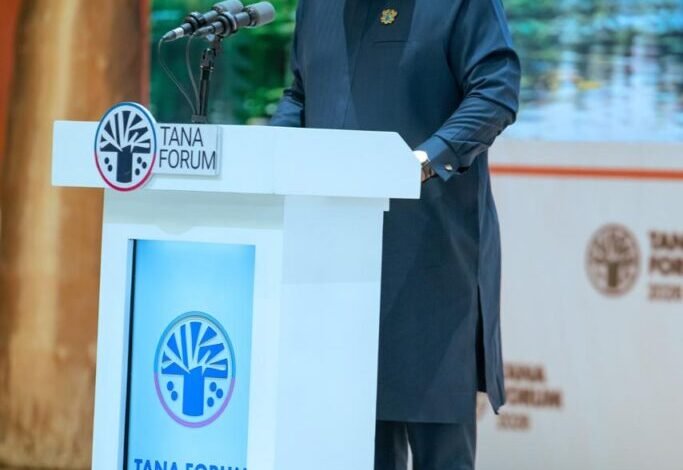
President John Dramani Mahama has renewed his call for African countries to exercise stronger control over critical mineral wealth, arguing that rising global demand for resources used in energy systems and digital technology must produce better outcomes for African communities. Speaking while presenting the 2026 Tana State of Peace and Security in Africa Report in Bahir Dar, Ethiopia, Mahama connected mineral extraction with conflict and exploitation, citing the eastern Democratic Republic of the Congo and disputes around uranium in Niger. His message was that political independence is incomplete when countries lack the capacity to manage strategic resources and negotiate agreements that deliver public benefit.
The remarks, reported by Ghana Broadcasting Corporation on October 25, place resource governance at the centre of a wider debate over industrialisation, security and Africa’s place in global supply chains. They also connect with Ghana’s domestic policy direction. At the Mining in Motion Summit in Accra earlier in October, Mahama set a goal for Ghana to end exports of unprocessed mineral resources by 2030, with a phased implementation roadmap. That is a policy target, not a claim that all raw-mineral exports have already been prohibited.
What the President means by resource control
Control over minerals is often discussed as a question of ownership, but Mahama’s argument reaches beyond who holds a licence or a share in a mine. It includes the ability of governments to set clear rules, negotiate contracts, enforce environmental obligations, collect revenue, build technical expertise and ensure that communities affected by extraction see tangible benefits. A country may produce a valuable mineral and still capture only a limited share of the value if processing, manufacturing, finance and key technical services are located elsewhere.
The distinction matters because critical minerals have become strategically important to industries such as batteries, electricity networks, electronics and renewable-energy systems. The demand for these materials can create opportunities for producers, but the opportunity is not automatic. A mineral deposit does not by itself create a competitive refinery, a manufacturing workforce or a stable supply chain. Those outcomes require capital, infrastructure, skilled labour, predictable regulation and markets that can buy the finished or semi-finished products.
Mahama’s Tana Forum remarks also framed resource governance as a security issue. In regions where extraction is linked to armed conflict, weak oversight or unequal benefits can deepen grievances. The President cited the eastern Democratic Republic of the Congo and uranium-related disputes in Niger as examples of the risks that can surround strategic resources. The speech did not mean that every mining project produces conflict; it argued that governance failures and competition over resources can intensify existing tensions.
Ghana’s 2030 value-addition target
The Presidency’s October 22 account of Mahama’s address at the Mining in Motion Summit said Ghana aims to halt the export of unprocessed mineral resources by 2030. The President described a phased approach supported by transparent regulatory timetables, targeted legislation and commodity-specific benchmarks. The announcement also referred to existing restrictions on iron scrap and non-ferrous metals. These are distinct measures: an existing restriction on particular materials should not be confused with the broader 2030 target for unprocessed ores.
Ghana has already identified parts of the value chain it wants to develop. The Ghana Integrated Aluminium Development Corporation provides a framework for linking bauxite resources with aluminium processing and manufacturing. The Ghana Integrated Iron and Steel Development Corporation is intended to connect iron-ore development with domestic steel production. The Ghana Gold Board and gold-refining policy are also part of efforts to retain more value through assaying, refining and related services, according to reporting on the summit.
Those institutions are frameworks for development, not proof that every stage of processing is ready to operate at commercial scale. A credible transition will need project milestones, investment decisions, reliable energy, transport links, environmental safeguards and skilled workers. The policy challenge is to turn a national ambition into a sequence of feasible projects that can compete on quality, cost and reliability while protecting communities and public finances.
Why local processing is difficult—and why it matters
Processing minerals domestically can create jobs and supplier opportunities, but it also requires substantial investment. Facilities need power, water, transport, maintenance, technical staff and consistent feedstock. A plant that is built before these systems are ready may struggle to operate competitively. Government and investors therefore have to assess whether a project has dependable inputs, a market for its output and a realistic financing plan. The aim should be sustainable production rather than a symbolic facility that cannot remain open.
Local value addition can extend beyond the final processing plant. Ghanaian firms may supply engineering, logistics, environmental services, equipment maintenance, laboratory testing, safety systems and other specialised services. A stronger domestic supplier base can help keep more expenditure in the economy and develop capabilities that are useful in other industries. That requires training, access to contracts, standards certification and finance that fits the time needed to build a business.
The Petroleum Commission’s local-content work in the oil and gas sector provides a related policy lesson: participation is not achieved by a rule alone. Indigenous firms need an environment in which they can compete, grow and sustain operations. The same principle applies to mining and mineral processing. Local-content requirements are most effective when paired with predictable procurement, transparent qualification standards, skills development and access to long-term capital.
A regional market can make the strategy more realistic
Mahama has also argued that Ghana’s mineral-processing efforts should be aligned with neighbouring countries. In an October 19 report, the Ghana News Agency said he pointed to Agenda 2063, the African Mining Vision and the African Continental Free Trade Area as foundations for regional cooperation. The idea is that countries can share geological knowledge, coordinate infrastructure and develop larger markets for African-produced inputs rather than each attempting to build every part of a value chain alone.
Regional cooperation could help create scale. One country may have a resource, another may have processing capacity, and a third may provide a market or specialised service. Shared standards and reliable cross-border trade can support investment in facilities that serve more than one national economy. But regional integration also depends on practical issues such as customs procedures, transport costs, payments, tariffs and confidence that agreements will be implemented.
Ghana’s role as host of the AfCFTA Secretariat gives it a platform to advocate for easier intra-African trade. The policy opportunity is to connect that diplomatic role with concrete industrial partnerships. Regional value chains need predictable rules and commercially viable projects; declarations alone cannot supply those conditions.
Communities must see the benefits
Resource sovereignty also has a local dimension. Communities near extraction and processing sites can face land-use changes, environmental pressure, traffic, noise and demands on public services. If residents see the costs while the benefits flow elsewhere, distrust can grow. A stronger minerals policy should therefore include consultation, transparent revenue arrangements, worker protection, land rehabilitation and accessible information about project impacts.
Local communities should not be treated as an afterthought once investment decisions have been made. They need clear channels to raise concerns, understand compensation and follow commitments. Environmental monitoring should be credible and publicly explained. The same standard applies to revenue: mineral proceeds should be accounted for and used in ways that can be scrutinised by citizens and oversight institutions.
Value addition is not a substitute for responsible extraction. A domestic refinery or manufacturing plant can still cause harm if environmental rules are weak or if workers are unprotected. The goal is to retain more economic value while improving governance, safety and the long-term condition of the land and water on which communities depend.
What to watch next
The most important test of the 2030 target will be the detail that follows it. Investors and citizens will need commodity-specific timelines, the legal steps required, clear rules for existing contracts, a transparent process for measuring progress and public information about the projects expected to supply processing facilities. The government will also need to explain how it intends to support local businesses without creating barriers that undermine competition or discourage investment.
Mahama’s Tana Forum message was a call for African governments to use mineral wealth as a foundation for development and security rather than a source of conflict and extraction without broad benefit. Ghana’s challenge is to translate that principle into rules and projects that are financially viable, environmentally responsible and accountable to citizens. The debate is no longer only about whether Africa has valuable minerals; it is about who captures the value, who bears the risks and what kind of economy the resources help build.
For more Ghana policy reporting, visit the Fly FM Ghana homepage and read the station’s earlier coverage of MIIF mineral royalties and its revenue target.
Sources