Ghana Teachers’ Strike: Negotiations Continue as Government and Unions Seek Resolution
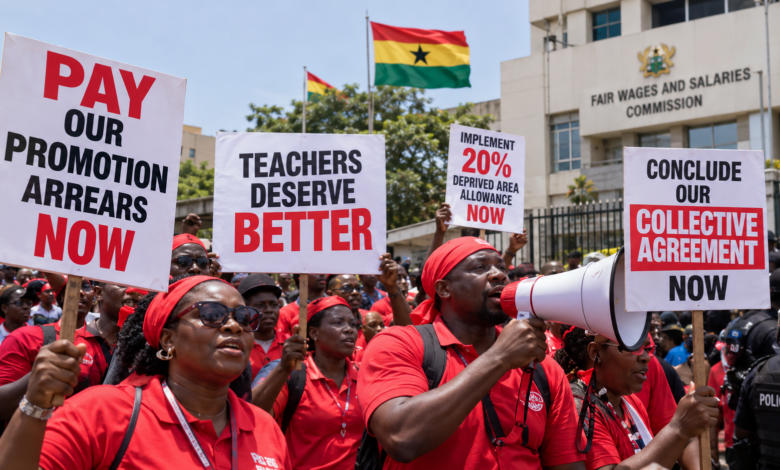
Ghana’s nationwide teachers’ strike remains in force as government and teacher unions continue negotiations over outstanding salary arrears, promotion placements, conditions of service and the proposed 20% deprived-area allowance. The latest meeting between the Fair Wages and Salaries Commission (FWSC) and the three major pre-tertiary teacher unions ended without a final agreement on October 6, 2026.
1. Why Are Ghanaian Teachers on Strike?
The Ghana teachers’ strike was declared after teacher unions said several long-standing issues affecting their salaries, promotions and working conditions had not been resolved. The nationwide industrial action began on September 25, 2026, involving major pre-tertiary teacher unions including GNAT, NAGRAT and PRETAG. According to the unions, the decision followed prolonged delays, unfulfilled commitments and unsuccessful engagements with government agencies over key employment concerns. Ghana National Association
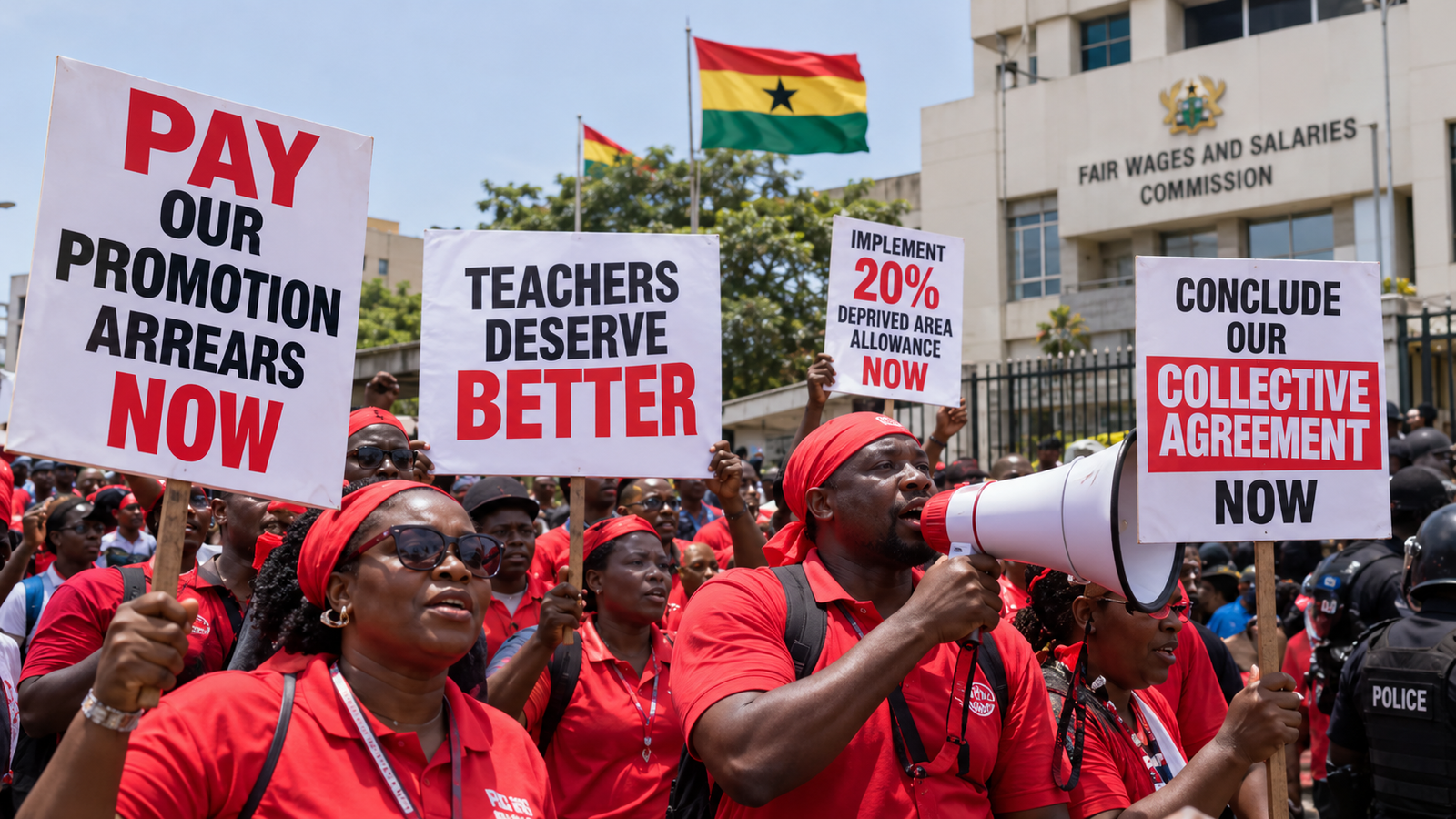
At the centre of the Ghana teachers’ strike are three major issues: the delay in negotiating a new collective agreement, the placement of promoted teachers on the appropriate salary scales and the implementation of the Deprived Area Allowance.
The existing collective agreement covering teachers’ conditions of service has expired. The unions say negotiations for a replacement agreement were expected to have been completed by June 2026, but the process remained unresolved. For teachers, a collective agreement is important because it establishes employment conditions, benefits and other workplace arrangements. Ghana National Association
Another major issue is teacher promotion arrears and salary placement. The unions want teachers who successfully passed promotion examinations to be placed on their appropriate salary grades, together with payment of outstanding arrears. The government has said it is working to process legitimate cases and has indicated that promotion arrears dating from January 2026 would be addressed after the necessary verification. Ghana National Association
The 20% Deprived Area Allowance is also a major part of the dispute. Teacher unions argue that educators working in rural, deprived and hard-to-reach communities should receive the allowance because of the difficult conditions under which they work. The unions have called for implementation of the allowance and a clear timetable for payment. Ghana National Association
The dispute has already affected teaching and learning in some public schools. Reports from different parts of Ghana have described classrooms and school compounds with significantly reduced activity during the industrial action. Ghana National Association
For parents and students, the Ghana teachers’ strike creates concerns about lost instructional time, examinations, academic schedules and preparations for important assessments. This is why the negotiations between the teacher unions and government are being closely followed.
The government has continued engaging the unions through the Ministry of Education, the Fair Wages and Salaries Commission and other relevant institutions. The objective is to resolve the outstanding issues and restore normal teaching and learning across the country.
For readers following wider education developments, see our coverage of Ghana News Today: Business, Education, Technology and Community Developments to Watch. Parents and students can also read Why Digital and STEM Skills Matter for Ghanaian Students for broader education-related developments in Ghana.
The Ghana teachers’ strike is therefore not simply about one outstanding payment. It involves a combination of teacher salary placement, promotion arrears, conditions of service, collective bargaining and allowances for educators working in difficult areas. Until the outstanding matters are resolved through negotiations, teachers, parents and students will continue watching for an official announcement on the next steps.
2. Latest Update on the Ghana Teachers’ Strike Negotiations
The Ghana teachers’ strike remains a major issue in the country’s education sector as government and teacher unions continue discussions aimed at resolving the concerns that led to the nationwide industrial action. The latest negotiations have focused on outstanding teacher promotion arrears, salary placements, conditions of service and the proposed allowance for teachers working in deprived areas.
The latest meeting between the Fair Wages and Salaries Commission (FWSC) and the major pre-tertiary teacher unions ended without a final agreement. The discussions are expected to continue as both sides work towards finding a solution that could bring the Ghana teachers’ strike to an end.
The negotiations involve the Ghana National Association of Teachers (GNAT), the National Association of Graduate Teachers (NAGRAT) and the Pre-Tertiary Education Teachers Association of Ghana (PRETAG). The unions have maintained that teachers should remain on strike until meaningful progress is made on the outstanding issues.
According to the Ghana News Agency’s latest report on the negotiations, the discussions ended inconclusively, meaning that the industrial action had not been officially suspended. The report also indicates that the parties were expected to continue negotiations.
The dispute has attracted significant attention because of its potential impact on Ghana’s public education system. Parents and students are concerned about missed lessons, examinations, academic schedules and the possible disruption of the school calendar if the strike continues for an extended period.
One of the key matters under discussion is the payment of arrears owed to teachers who have been promoted but are still waiting for their new salary placements. The government has previously indicated that it is working to validate and process eligible cases. More details about this issue are available in our report on promoted teachers receiving upgraded salaries and arrears.
Another important issue is the proposed 20% deprived-area allowance. Teachers and their unions argue that educators working in rural and hard-to-reach communities require additional incentives because of the challenges associated with those postings. Readers can also follow our education news coverage in Ghana for further updates.
The negotiations are also connected to the broader issue of teachers’ conditions of service and the need for a new collective agreement. A collective agreement provides an important framework for employment conditions, benefits and other workplace matters affecting teachers.
For parents looking for information about how prolonged school disruptions can affect students, our Ghana Education and Schools Guide provides additional education-related information.
For official government information and broader education policy developments, readers can also consult the Ministry of Education Ghana website.
At this stage, there is no confirmed date for the end of the Ghana teachers’ strike. The next round of negotiations will therefore be closely watched by teachers, parents, students and education stakeholders across the country.
The outcome of the discussions could determine whether teachers return to classrooms or whether the industrial action continues. Until the teacher unions officially announce a suspension or end to the strike, teachers are expected to follow the position communicated by their respective unions.
3. GNAT, NAGRAT and PRETAG Maintain the Strike
The Ghana teachers’ strike continues as the major pre-tertiary teacher unions maintain their position that teachers should remain away from the classroom while negotiations with the government continue. The Ghana National Association of Teachers (GNAT), National Association of Graduate Teachers (NAGRAT) and Pre-Tertiary Education Teachers Association of Ghana (PRETAG) are at the centre of the ongoing discussions over salaries, promotion arrears, conditions of service and allowances.
The unions have argued that the industrial action became necessary after several concerns affecting teachers remained unresolved despite previous engagements with government representatives. Their position is that commitments made during earlier discussions must be translated into concrete action before teachers can be expected to return to classrooms.
According to the Ghana News Agency report on the latest negotiations, discussions between the unions and the Fair Wages and Salaries Commission ended inconclusively, with further negotiations expected. This means the Ghana teachers’ strike remains in force while both sides work towards a possible resolution.
The unions are particularly concerned about teachers who have passed promotion examinations but are still waiting for their appropriate salary placements and outstanding payments. The issue of promotion arrears has become one of the most important demands in the dispute because affected teachers say delays have created financial pressure and uncertainty.
The government has previously indicated that it is working to process eligible promotion cases and pay outstanding arrears after verification. More information on this issue can be found in our latest education and teacher salary news.
Another major demand involves the proposed 20% allowance for teachers working in deprived areas. GNAT, NAGRAT and PRETAG have argued that teachers serving in rural and difficult-to-reach communities deserve additional financial support because of the challenges associated with those postings.
The unions are also seeking progress on a new collective agreement covering teachers’ conditions of service. Issues covered by such agreements can include employment conditions, allowances, welfare arrangements and other workplace matters.
The continuing strike has raised concerns among parents and students about lost instructional time. If the dispute lasts for an extended period, schools may have to consider how missed lessons and academic activities will be recovered.
Parents and students can follow our Ghana education news updates for developments affecting schools and the academic calendar.
For official information about national education policy and government programmes, readers can also visit the Ghana Ministry of Education.
For now, GNAT, NAGRAT and PRETAG continue to press their demands while negotiations proceed. The next stages of discussions will be important in determining whether the Ghana teachers’ strike can be resolved and teachers can return to their classrooms.
Until an official announcement is made by the teacher unions, the industrial action remains a major issue for Ghana’s education sector. Teachers, parents and students will be watching closely for any breakthrough that could restore normal teaching and learning across the country.
4. Teacher Salary Arrears and Promotion Placements
One of the biggest issues behind the Ghana teachers’ strike is the delay in placing promoted teachers on their appropriate salary grades and paying outstanding promotion-related arrears. For many teachers, promotion is expected to come with improved responsibilities and corresponding salary adjustments. However, delays in processing these changes have become a major source of frustration within the teaching profession.
Teachers who successfully completed promotion examinations and met the required conditions expect their new positions to be reflected in their salaries. Where the placement is delayed, affected teachers may continue receiving their previous salary while waiting for the financial benefits associated with their promotion. This has made promotion arrears one of the key issues being discussed during negotiations between teacher unions and government.
The government has indicated that it is working to validate and process eligible cases. According to the Ghana News Agency report on promoted teachers, government announced plans for promoted teachers to receive upgraded salaries and outstanding arrears after the necessary processes have been completed.
The issue is important because teacher promotion is not simply a change in job title. It can involve additional professional responsibilities, expectations and financial adjustments. Teachers who have completed the required promotion process therefore want their new salary placement to reflect their professional status.
The dispute over promotion arrears has also become closely connected to the wider Ghana teachers’ strike because the unions want clear commitments and timelines for resolving outstanding cases. They have called for affected teachers to receive the payments they are entitled to rather than waiting indefinitely for administrative processes to be completed.
For teachers and education workers looking for additional information, our Ghana education news section provides updates on salaries, promotions, schools and other developments affecting the education sector.
The government has stressed the importance of verifying promotion records before payments are made. This process is intended to ensure that only eligible teachers receive upgraded salary placements and arrears. While verification can help prevent errors in public payroll administration, delays can create uncertainty for teachers who have already completed the required promotion procedures.
The issue also highlights the importance of efficient public-sector payroll management. When salary upgrades are delayed, workers may face difficulties planning household finances, meeting financial commitments and managing other expenses.
The Ghana Ministry of Education remains an important official source for information about education policy, teacher management and government programmes affecting schools and educators.
The resolution of teacher promotion arrears is therefore expected to remain an important part of negotiations. A clear timetable, accurate verification and timely payment could help rebuild confidence between the government and teacher unions.
Until the outstanding concerns are adequately addressed, teacher salary arrears and promotion placements will remain central to discussions surrounding the Ghana teachers’ strike. Teachers, parents and other education stakeholders will continue watching the negotiations for concrete progress and an eventual return to normal teaching and learning.
5. Government’s Position on Outstanding Payments
The government’s position on outstanding teacher payments has become an important part of the negotiations surrounding the Ghana teachers’ strike. Government officials have maintained that efforts are underway to address legitimate claims involving promotion placements, salary adjustments and arrears owed to eligible teachers.
The issue of outstanding payments is particularly important for teachers who have completed promotion processes but are still waiting for their new salary grades to be reflected in their monthly pay. Teacher unions have repeatedly called for these cases to be resolved, arguing that prolonged delays have placed financial pressure on affected educators.
The government has said that the payment process requires proper verification of teachers’ records. This is intended to ensure that promotion placements and arrears are calculated correctly before payments are made. According to the Ghana News Agency report on promoted teachers, government announced that promoted teachers would receive upgraded salaries and arrears after the necessary validation and processing.
Education Minister Haruna Iddrisu has also indicated that government remains committed to resolving outstanding issues affecting teachers. The government’s approach has been to engage the unions while working through the administrative and financial processes required to validate eligible claims.
For teachers, however, the key concern is when the outstanding payments will actually reach their accounts. A commitment to process arrears is different from receiving the money, which is why the teacher unions have continued to demand clear timelines and concrete action.
The issue has become closely connected to the wider Ghana teachers’ strike because salary arrears and promotion placements are among the matters the unions want resolved before the industrial action can be brought to an end. Teachers are seeking assurance that approved promotions will result in the appropriate salary adjustments and that outstanding payments will not continue to accumulate.
Readers can follow our Ghana education news coverage for further updates on teacher salaries, schools and education policy.
The government must also balance the need to settle legitimate claims with the requirement to maintain accurate public payroll records. Proper verification can reduce errors and prevent incorrect payments, but lengthy administrative delays can also contribute to frustration among teachers.
For official information about government education policies and programmes, readers can consult the Ghana Ministry of Education.
The negotiations therefore remain important for both sides. Government wants to demonstrate that it is addressing outstanding obligations, while the teacher unions want evidence that affected educators will receive the payments and salary adjustments they are owed.
The outcome could have a direct impact on the future of the Ghana teachers’ strike. If the government and unions reach an acceptable agreement on outstanding payments, it could help create the conditions for teachers to return to classrooms. If significant disagreements remain, however, the industrial action could continue while negotiations proceed.
For now, teachers and education stakeholders are waiting for further developments and a clear indication from both government and the unions on how the outstanding payment issues will be resolved.
6. The 20% Deprived-Area Allowance
The proposed 20% deprived-area allowance has become one of the major issues connected to the Ghana teachers’ strike. Teacher unions are calling for additional financial support for educators who work in rural, deprived and hard-to-reach communities, where teachers may face challenges that are different from those experienced in larger towns and cities.
The purpose of a deprived-area allowance is to provide an incentive for teachers to accept and remain in postings where schools may have limited infrastructure, fewer educational resources and difficult transportation conditions. Teacher unions argue that additional financial support could help attract and retain qualified teachers in communities that traditionally struggle to fill teaching positions.
The demand has therefore become an important part of negotiations between the government and teacher unions. The unions have called for the proposed allowance to be implemented with clear criteria and a reliable payment arrangement.
According to the Ghana News Agency report on teacher unions supporting the strike, the deprived-area allowance is among the concerns being raised by teacher representatives during the ongoing dispute.
For teachers working in remote communities, the cost of transportation, accommodation and other everyday expenses can be significant. In some areas, educators may also have to travel long distances to access basic services. An additional allowance could therefore provide financial recognition for the conditions under which these teachers work.
The issue is also connected to the wider challenge of ensuring equal access to quality education across Ghana. When schools in rural communities struggle to attract and retain experienced teachers, students in those areas can face disadvantages compared with students in better-resourced urban schools.
The proposed allowance could form part of a broader strategy for improving teacher distribution across the country. Rather than having qualified educators concentrated in major cities and urban centres, incentives could encourage more teachers to accept postings in underserved communities.
Readers can follow our Ghana education news section for more reports about schools, teachers and education policies.
The implementation of the allowance would also require clear identification of qualifying schools and communities. Government and the teacher unions would need to agree on the criteria used to determine which teachers and locations qualify for the payment.
For official information about Ghana’s education policies and programmes, readers can visit the Ghana Ministry of Education.
The 20% allowance has consequently become more than a salary-related demand. It is also part of the wider conversation about teacher welfare, rural education and the distribution of educational resources across Ghana.
As negotiations continue, the teacher unions are expected to keep pressing for clarity on when the allowance will begin, who will qualify and how payments will be administered.
The resolution of the deprived-area allowance could therefore influence the outcome of the Ghana teachers’ strike. If both sides reach an agreement on the allowance alongside the other outstanding issues, it could help move the negotiations towards a settlement and eventually support the return of teachers to classrooms.
7. New Collective Agreement for Teachers
The demand for a new collective agreement is another important issue behind the Ghana teachers’ strike. Teacher unions have been calling for negotiations on a new agreement covering the conditions of service of pre-tertiary teachers, including employment arrangements, allowances, welfare issues and other matters affecting educators.
A collective agreement provides a framework for negotiations between workers and their employer. For teachers, it can help establish clear rules and expectations regarding salaries, benefits, allowances, professional responsibilities and workplace conditions. When an agreement expires without a replacement being concluded, uncertainty can develop around several employment-related issues.
The teacher unions have therefore made the new collective agreement one of their priorities in discussions with government. They argue that negotiations should produce a comprehensive agreement that reflects the current realities facing teachers and provides improved conditions for educators across Ghana.
According to the Ghana News Agency report on the teacher unions’ position, the collective agreement is among the outstanding matters being raised by the unions during the dispute.
The negotiations are taking place against the background of other unresolved issues, including promotion placements, salary arrears and the proposed 20% allowance for teachers working in deprived areas. These issues are interconnected because they all relate to the broader question of teacher welfare and working conditions.
For teachers, a new collective agreement could provide greater clarity about their employment rights and obligations. It could also establish a formal basis for addressing future disputes between teacher representatives and government.
The negotiations are particularly significant because Ghana’s public education system depends heavily on the availability and motivation of qualified teachers. Improving working conditions can help support teacher retention and encourage experienced educators to remain in the profession.
Parents and students are also indirectly affected by the outcome. Stable employment conditions can contribute to a more predictable education system, while prolonged disputes can lead to interruptions in classroom teaching.
Readers can follow our Ghana education news coverage for updates on teacher negotiations, schools and other developments affecting education.
Government and the teacher unions will need to agree on the specific provisions of the new collective agreement before it can be implemented. This means negotiations may cover several areas, including financial benefits, professional development, welfare arrangements and other employment conditions.
For official information about education policy and government programmes, readers can consult the Ghana Ministry of Education.
The new collective agreement is therefore an important part of the wider negotiations surrounding the Ghana teachers’ strike. A successful agreement could provide teachers with clearer employment conditions while giving government and the unions a framework for resolving future workplace disputes.
As negotiations continue, teachers and other education stakeholders will be watching for progress on the collective agreement alongside the other outstanding demands. Reaching a comprehensive settlement could help create the conditions needed for the industrial action to end and normal teaching and learning to resume.
8. Impact of the Strike on Ghana’s Education System
The ongoing Ghana teachers’ strike is having a significant impact on teaching and learning, particularly in public pre-tertiary schools where teachers represented by the major unions have withdrawn their services. The industrial action has raised concerns among parents, students, school authorities and education stakeholders about lost instructional time and the possible effect on the academic calendar.
When teachers are absent from classrooms for an extended period, students can miss important lessons, revision sessions, assignments and other academic activities. The effect can be particularly serious for students preparing for examinations because they may have less classroom time to complete the required curriculum and receive guidance from their teachers.
Reports from some communities have already highlighted disruptions to normal school activities since the strike began. The Ghana News Agency has reported on the disruption to teaching in schools, illustrating how the industrial action is affecting school operations.
The impact of the Ghana teachers’ strike is not limited to students. Parents may also face additional challenges when children remain at home during normal school hours. Working parents, in particular, may have to make alternative arrangements for childcare while waiting for negotiations between government and the teacher unions to produce a solution.
Schools could also face pressure to recover lost instructional time if teachers eventually return after a prolonged disruption. Education authorities may need to review academic schedules and determine whether additional teaching periods or adjustments to planned activities are necessary.
The situation has also renewed discussions about the importance of resolving labour disputes in the education sector quickly. Teachers need fair and predictable employment conditions, while students need consistent access to classroom instruction.
For parents and students seeking more information about developments affecting schools, our Ghana education news coverage provides updates on education policy, schools and teacher-related developments.
A prolonged disruption could have a greater effect on students in examination classes. These students may have limited time to recover missed lessons before important examinations, making timely resolution of the dispute particularly important.
The strike also highlights the relationship between teacher welfare and educational outcomes. Issues such as salary arrears, promotion placements, allowances and conditions of service can influence teacher morale, recruitment and retention. Addressing these concerns can therefore form part of efforts to strengthen Ghana’s education system.
For official information about education policy, programmes and government responses, readers can visit the Ghana Ministry of Education.
At the same time, the impact of the Ghana teachers’ strike will depend on how long the industrial action continues. A short disruption may be easier for schools to recover from, while a prolonged strike could require more substantial adjustments to the academic calendar.
The government and teacher unions therefore face pressure to reach an acceptable agreement. Resolving the outstanding issues would allow teachers to return to classrooms and enable schools to focus again on teaching, learning and examination preparation.
Until a settlement is reached and the unions officially suspend the industrial action, parents and students will continue to monitor the negotiations closely. The return of teachers to classrooms will be an important step towards restoring normal academic activities across Ghana.
9. What Happens Next?
The next stage of the Ghana teachers’ strike will depend largely on the outcome of continued negotiations between the government and the teacher unions. With several important issues still under discussion, both sides are under pressure to find a solution that addresses teachers’ concerns while allowing normal teaching and learning to resume.
The Fair Wages and Salaries Commission (FWSC) has been involved in discussions with the major pre-tertiary teacher unions, including GNAT, NAGRAT and PRETAG. The negotiations have focused on issues such as promotion arrears, salary placements, conditions of service and the proposed 20% allowance for teachers working in deprived areas.
The latest discussions ended without a final agreement, meaning the Ghana teachers’ strike remains unresolved. According to the Ghana News Agency’s latest report on the negotiations, the parties were expected to continue discussions as they seek a way forward.
One of the immediate priorities will be determining how outstanding promotion-related payments can be processed. Teachers who have been promoted want their new salary placements and eligible arrears addressed, while government officials have stressed the importance of verifying records before payments are made.
Another key issue is the proposed deprived-area allowance. The unions want clarity about the implementation, eligibility requirements and payment arrangements for teachers working in underserved communities.
The parties will also need to make progress on the new collective agreement covering teachers’ conditions of service. Reaching an agreement on this issue could provide a longer-term framework for addressing employment concerns and reducing the possibility of similar disputes in the future.
For readers following developments in Ghana’s education sector, our latest education news provides additional reports on teachers, schools and government education policies.
The duration of the industrial action will be an important factor. If negotiations produce significant progress, the unions could consider whether to suspend the strike and allow teachers to return to classrooms. If major disagreements remain, however, the strike could continue while further negotiations take place.
Parents and students will also be watching the situation closely because a prolonged disruption could affect lesson schedules, examinations and other academic activities. Schools may eventually need to make arrangements to recover instructional time if normal teaching resumes after an extended interruption.
For official information about government education policy and programmes, readers can consult the Ghana Ministry of Education.
The next negotiations therefore represent an important opportunity for both sides. Government will need to demonstrate progress on the outstanding commitments, while the teacher unions will need to assess whether the proposals presented are sufficient to address the concerns of their members.
The Ghana teachers’ strike will ultimately end only when the unions and government reach an acceptable resolution and the unions communicate a decision to their members. Until then, teachers, parents, students and education stakeholders will continue waiting for updates from the negotiating parties.
The coming discussions could therefore determine whether Ghana’s schools return to normal operations or whether the industrial action continues. A successful settlement would provide relief for teachers while allowing students to return to regular classroom learning.
10. When Will Teachers Return to the Classroom?
The big question now is when teachers will return to the classroom as the Ghana teachers’ strike continues. As of October 6, 2026, there is no confirmed date for teachers to resume normal classroom duties because negotiations between the teacher unions and government have not yet produced a final agreement.
The latest discussions between the Fair Wages and Salaries Commission (FWSC) and the three major pre-tertiary teacher unions ended without agreement. The latest Ghana News Agency report on the teachers’ strike confirms that teachers will remain on strike while negotiations continue. The parties are expected to reconvene as they work towards resolving the outstanding issues.
The teacher unions involved are GNAT, NAGRAT and PRETAG. Readers can also check the Ghana National Association of Teachers for information concerning teachers and union activities. GNAT describes itself as a teacher organisation focused on improving the conditions of service of its members.
Another important source is the Pre-Tertiary Teachers Association of Ghana, which provides information about teacher welfare, advocacy and the current industrial action.
The negotiations are expected to address several outstanding concerns, including teacher promotion arrears, salary placements, the proposed 20% deprived-area allowance and a new collective agreement.
One of the government’s major commitments concerns teacher promotion arrears. Education Minister Haruna Iddrisu has pledged that promotion arrears dating from January 2026 would be paid by October 30, 2026. The Ghana News Agency report on the payment timeline provides details of that commitment.
The Controller and Accountant-General’s Department is particularly relevant because government payroll processing and salary administration are part of the process for addressing upgraded salary placements and related payments. CAGD has also published information concerning payroll validation for teachers.
Teachers and parents can also check the Ghana Education Service for official information about pre-tertiary education administration, schools and education programmes. GES is responsible for implementing approved national education policies and managing public pre-tertiary education.
The National Teaching Council is another important education authority for teachers, particularly on professional standards, teacher licensing and professional development.
The proposed 20% deprived-area allowance remains another important part of the negotiations. Government has previously said that a validation process would be used to determine eligible teachers and communities. Readers can follow the Education Ministry’s official website for government information on education policy and programmes.
The teacher unions, however, have maintained that they want concrete progress rather than assurances before calling off the industrial action. A MyJoyOnline report on the government’s roadmap outlines the proposed timelines for addressing the major concerns.
The situation has also attracted attention from the presidency and other government institutions. A 3News report on the presidential engagement with teacher unions provides additional background on government efforts to resolve the dispute.
The impact on students is another major concern. Reports indicate that some schools have experienced significant disruption, with pupils appealing for teachers to return so that academic activities can resume. The Ghana News Agency report on pupils affected by the strike highlights concerns about missed lessons and examination preparation.
For readers following the wider education story, FLY FM Ghana’s education coverage provides additional context about education developments and their effect on students, families and communities.
Parents and students can also read 10 Study Habits That Help Students Achieve Academic Success for practical ways students can continue learning and preparing while normal classroom activities are disrupted.
Another useful internal resource is Why Digital and STEM Skills Matter for Ghanaian Students, which discusses skills that can support students beyond traditional classroom learning.
For broader national developments, readers can continue following the FLY FM Ghana homepage for breaking news, education, business, sports and entertainment updates.
The latest negotiations are particularly important because the unions have clearly stated that the strike will continue while discussions remain unresolved. MyJoyOnline’s report on the scheduled FWSC negotiations explains that the discussions were expected to focus on the expired conditions of service and collective agreement.
Regional teacher unions have also continued to support the industrial action. The Ghana News Agency report from the Western Region reported continued support for the nationwide action over conditions of service, promotion placements and allowances.
Similarly, teacher unions in the Volta Region have reaffirmed their support for the strike. The GNA report on the Volta Region teacher unions provides further information about their position.
The National Association of Graduate Teachers has also maintained its position on the industrial action. Readers can review the GNA report on NAGRAT’s position for further details.
The Ghana Education Service resources page is also useful for official education documents, policies and teacher-related resources.
For information about the administration of public education, readers can also consult the GES mandate and vision page, which explains the Service’s responsibilities for pre-tertiary education.
Finally, the CAGD core functions page provides official information about government payments and payroll responsibilities, making it a useful reference when following developments involving teacher salary payments and arrears.
What Teachers, Parents and Students Should Expect
For now, there is no confirmed return-to-school date. The Ghana teachers’ strike remains active because negotiations have not yet produced a settlement. Teachers are expected to remain on strike while the unions and government continue discussions.
The immediate focus will be on whether the next negotiations can produce concrete commitments on promotion arrears, salary placements, the deprived-area allowance and the new collective agreement.
If an agreement is reached and the unions officially suspend the industrial action, teachers could return to classrooms and schools could begin planning how to recover lost instructional time. Until that happens, parents and students should rely on official announcements rather than rumours circulating on social media.
The next round of negotiations will therefore be crucial. A successful agreement could bring an end to the Ghana teachers’ strike, restore normal teaching and learning and provide a clearer framework for addressing teachers’ concerns in the future.
FAQ
1. Is the GFAQhana teachers’ strike still ongoing?
Yes. The Ghana teachers’ strike remains in force after negotiations between the teacher unions and the Fair Wages and Salaries Commission ended without a final agreement on October 6, 2026. The parties are expected to continue negotiations.
2. Which teacher unions are involved in the Ghana teachers’ strike?
The major unions involved include the Ghana National Association of Teachers (GNAT), the National Association of Graduate Teachers (NAGRAT) and the Pre-Tertiary Education Teachers Association of Ghana (PRETAG).
3. Why are Ghanaian teachers on strike?
The major concerns include outstanding promotion placements and arrears, the expired collective agreement and implementation of the 20% deprived-area allowance.
4. When will teachers return to school?
There is currently no confirmed return-to-school date. The unions have said the strike will continue while negotiations remain unresolved.
5. What are teachers demanding about promotion arrears?
Teachers are demanding appropriate salary placement following promotion examinations and payment of the corresponding arrears. The Education Minister has pledged that promotion arrears from January 2026 would be settled by October 30, 2026.
6. What is the 20% deprived-area allowance?
It is an allowance being demanded for teachers serving in deprived and hard-to-reach communities. Teacher unions say its implementation is necessary to recognise the difficult conditions faced by educators in such areas.
7. Will the teachers’ strike affect students?
Yes. The industrial action has disrupted teaching in public schools, with reports of closed schools and students missing classroom instruction.
8. When are negotiations expected to continue?
Following the inconclusive October 6 meeting, the parties agreed to reconvene on Wednesday to continue negotiations.