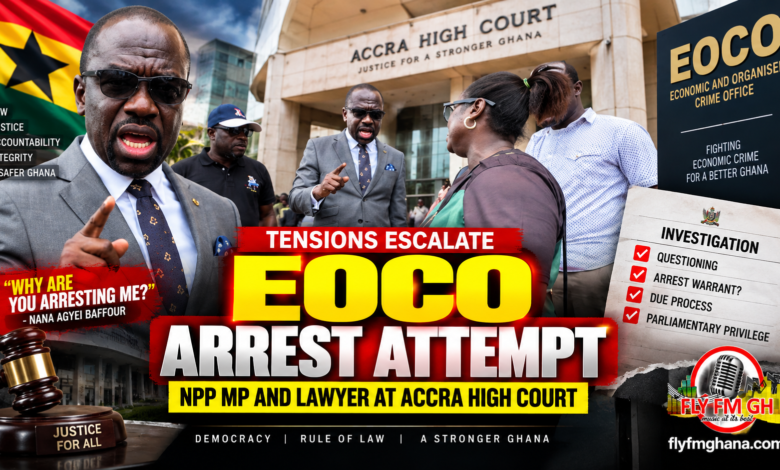
Tensions Rise at Accra High Court as EOCO Officials Seek to Take NPP MP Nana Agyei Baffour Awuah Into Custody
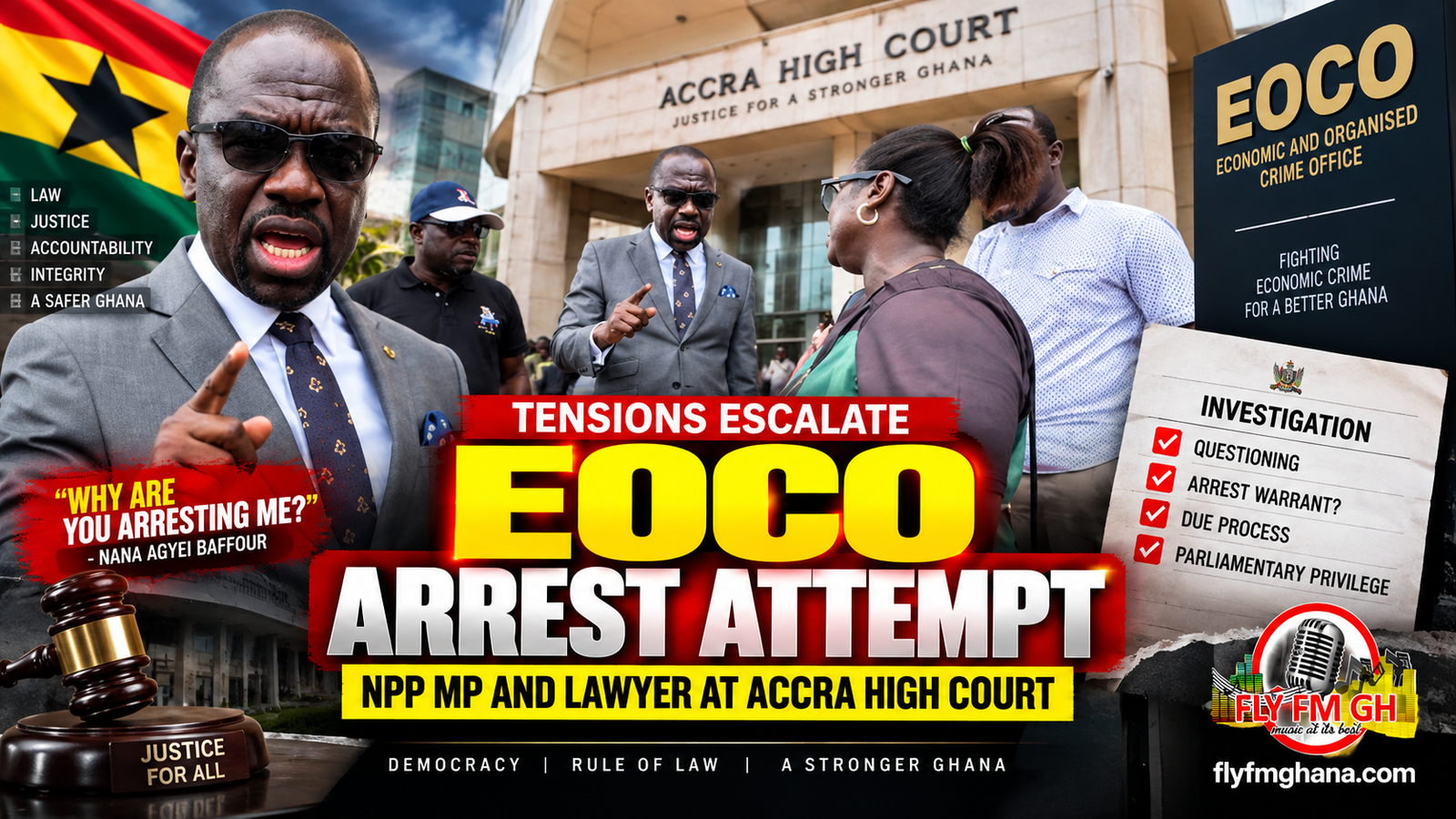
Tensions rose at the Accra High Court on Wednesday, September 23, 2026, after officials believed to be from the Economic and Organised Crime Office (EOCO) attempted to take Manhyia South Member of Parliament and lawyer Nana Agyei Baffour Awuah into custody following proceedings in the ongoing Ghana Jollof case.
The EOCO arrest attempt at the Accra High Court has raised questions about the circumstances surrounding the incident.
The circumstances surrounding the incident remain unclear, with EOCO yet to publicly explain the legal basis for the reported action. (MyJoyOnline)
The confrontation happened after Nana Agyei Baffour Awuah appeared at the High Court as legal counsel for Salomey Awiti Bafoh, a senior nurse who is facing a criminal case connected to the alleged publication and circulation of false information through social media. According to reports from the court, the bail hearing involving Bafoh was adjourned to Thursday, September 24, after prosecutors requested additional time to respond to the defence application. (Adomonline.com)
What happened outside the courtroom quickly became one of the major Ghana news stories of the day. Video footage circulating from the scene showed a woman identifying herself as an EOCO officer approaching the MP and asking him to accompany her to the agency’s office. Nana Agyei Baffour Awuah questioned why he was being taken to EOCO and reportedly asked whether there was an arrest warrant or formal invitation supporting the action. (MyJoyOnline)
The incident has generated renewed attention around law enforcement, parliamentary privileges, legal representation, criminal investigations and the rights of individuals during an investigation. It has also raised questions about the relationship between Ghana’s anti-corruption institutions and elected members of Parliament when a legislator becomes connected to a criminal investigation or represents someone under investigation.
What Happened at the Accra High Court?
According to accounts published after the incident, Nana Agyei Baffour Awuah had just completed court proceedings involving his client when a woman believed to be an EOCO official approached him. The MP said the woman asked him to follow her to EOCO because he was allegedly needed at the office. He questioned why EOCO had not formally invited him if investigators wanted him to appear. (MyJoyOnline)
The MP later told journalists in Parliament that the woman claimed he had previously been invited but had failed to attend. Nana Agyei Baffour Awuah disputed that account and said he had not received such an invitation. He also said he wanted to know whether an arrest warrant existed and why he was being asked to surrender himself to the investigators. (MyJoyOnline)
The confrontation became physical when the woman reportedly stood near the entrance of his vehicle. Video footage reviewed by several Ghanaian media organisations showed a tense exchange before a member of the lawyer’s team opened the car door and the MP eventually drove away. MyJoyOnline reported that security personnel believed to be connected to EOCO appeared to follow the vehicle after it left the court premises. (MyJoyOnline)
It is important, however, to distinguish what is visible in the video from what has been established officially. While several media organisations reported that the individuals involved were believed to be EOCO personnel, EOCO had not publicly issued a statement explaining the operation or confirming the precise purpose of the attempted arrest at the time of reporting. (CitiNewsroom.com)
That distinction is particularly important in a developing criminal justice story. An attempted arrest, an invitation for questioning and a formal arrest warrant are different legal circumstances, and the available reports do not yet establish all the details surrounding the action against the MP.
Why Was EOCO Reportedly Seeking the MP?
The immediate reason for the reported attempt to take Nana Agyei Baffour Awuah to EOCO remains uncertain. Sources cited by Citi News said the matter was connected to an investigation involving the Ghana Jollof TikTok account and alleged failure by the MP to honour invitations from EOCO. Those same sources said the MP had not received an invitation. EOCO had not publicly confirmed either version when the report was published. (CitiNewsroom.com)
The connection to the Ghana Jollof investigation is significant because the case has expanded beyond the original social media content and now involves allegations concerning the dissemination of material, financial transactions and people allegedly connected to the online activities.
The Ghana Police Service previously said it had arrested Salomey Awiti Bafoh in connection with the investigation. According to police, Bafoh allegedly assisted in disseminating videos associated with Barbara Asantewaa Kodua, who police identified as the operator of the “Ghana Jollof” TikTok account. Police also said investigators had examined mobile phones, audio and video files and mobile money transaction records as part of their investigation. (3News)
Readers following the financial side of the investigation can also see our earlier coverage of the Ghana Jollof funding investigation, which examines the police claims about alleged financial links and digital evidence.
The police have described some individuals as “highly influential persons” in relation to alleged financial support, but the authorities have not publicly established that every person whose name or transaction may have appeared during an investigation has committed a criminal offence. Financial records can form part of an investigation, but criminal responsibility ultimately requires evidence and due process.
The Ghana Jollof Case Behind the Court Proceedings
The court appearance involving Nana Agyei Baffour Awuah was connected to the case against Salomey Awiti Bafoh. Police have accused Bafoh of involvement in the dissemination of material produced by Barbara Asantewaa Kodua through social media platforms. Bafoh has been remanded while the case continues through the legal process. (Ghana News Agency)
The Ghana Police Service declared Barbara Asantewaa Kodua wanted on September 18, 2026, alleging that she had used the Ghana Jollof TikTok account to publish material that police considered false, offensive or inciting. Police said she was believed to be in the United Kingdom. (Ghana News Agency)
The case has attracted considerable public attention because it involves social media, alleged false news, digital evidence, financial transactions and questions about the limits of online expression.
For Ghana’s digital media industry, the case also highlights the importance of understanding online publishing laws. Content creators, bloggers, social media influencers and website operators can reach large audiences quickly, but allegations involving crime, national security and public officials can carry serious legal consequences.
The Ghana Police Service’s account of the investigation provides important background to the case, while the court proceedings will determine the legal issues involving the accused persons.
Nana Agyei Baffour Awuah’s Role as a Lawyer
The MP was at the Accra High Court primarily as a lawyer representing Salomey Awiti Bafoh. This aspect of the incident has become important because the confrontation occurred immediately after he had participated in proceedings involving his client.
The lawyer’s role in criminal proceedings is to represent the interests of the accused within the law. Representation does not mean that a lawyer personally accepts or endorses every allegation made against a client. It is part of the legal system that an accused person is entitled to legal representation and a fair opportunity to answer allegations.
Nana Agyei Baffour Awuah has publicly defended aspects of his client’s case and has challenged the circumstances surrounding her detention. The reported EOCO encounter therefore occurred against the backdrop of an already contentious legal matter.
The incident has also raised questions about whether the MP was being approached as a lawyer, a witness, a person of interest or in another capacity. The available reports do not provide a definitive answer to that question.
That is why an official explanation from EOCO would be important for understanding the circumstances. The agency’s mandate covers investigations into economic and organised crime and other serious offences, including money laundering, prohibited cyber activity and tax fraud. (Eoco)
What EOCO Does in Ghana
EOCO is a specialised public institution responsible for investigating economic and organised crime. According to its official website, the agency can investigate serious offences and, on the authority of the Attorney-General, prosecute offences within its mandate and recover proceeds of crime. (Eoco)
Its responsibilities include investigations relating to money laundering, human trafficking, prohibited cyber activity, tax fraud and other serious offences. The agency also works with other law enforcement and investigative bodies.
The role of EOCO makes the current incident especially sensitive. When an anti-crime institution seeks to question or arrest a sitting Member of Parliament, the circumstances surrounding the action naturally attract public attention.
However, the existence of a parliamentary seat does not automatically make a legislator immune from criminal investigation. At the same time, Ghanaian law provides certain protections concerning parliamentary proceedings and the service or execution of legal processes involving Members of Parliament.
The precise circumstances therefore matter. Whether Parliament was sitting, whether the MP was travelling to or from a parliamentary proceeding, whether a warrant existed, whether the action related to a criminal offence and whether other legal procedures applied are all questions that would need to be established before drawing conclusions about the legality of the incident.
Parliamentary Privileges and the Arrest Question
Ghana’s Parliament Act, 1965, contains provisions concerning immunity from service of process and arrest in specified circumstances. The law provides protections for a Member of Parliament while attending Parliament, travelling to or from parliamentary proceedings and within parliamentary precincts while Parliament is sitting, subject to the statutory provisions and exceptions. (Parliament Repository)
This is different from saying that an MP can never be arrested or investigated. Parliamentary privilege has a specific legal scope and should not be confused with blanket immunity from criminal investigation.
The circumstances at the Accra High Court are therefore important. The incident did not reportedly take place inside the parliamentary chamber. It happened at the High Court after the MP had participated in proceedings as a lawyer.
The Parliament of Ghana also has a Committee of Privileges and Immunities responsible for investigating complaints involving contempt of Parliament or breaches of parliamentary privilege formally referred to the House. (Parliament of Ghana)
Whether that parliamentary process becomes relevant to this incident will depend on what is formally established about the circumstances.
For readers interested in Ghana’s broader constitutional and legal developments, our earlier report on the President Mahama Supreme Court case provides additional context on how constitutional questions can become subject to judicial interpretation.
What the Law Says About Arrest
Ghana’s Criminal and Other Offences Procedure Act provides a legal framework governing arrests. Section 3 of the Act states that an arrest is made when an authorised person actually touches or confines the body of the person to be arrested, unless the person submits to custody verbally or by conduct. (Parliament of Ghana)
This legal framework matters because the events outside the High Court involved an apparent attempt to persuade the MP to accompany an official to EOCO, followed by a physical confrontation and his departure from the premises.
The available footage and reports do not, by themselves, establish every legal detail concerning the intended action. That is why the question of whether there was a warrant, whether an invitation had previously been issued, what offence was being investigated and whether EOCO had lawful authority to act in the circumstances remains important.
Nana Agyei Baffour Awuah said he asked about an arrest warrant during the confrontation and that the woman could not produce one. That is his account of the incident, and it has not yet been independently established by an official EOCO statement. (MyJoyOnline)
The MP’s Earlier Cocaine Claims
Another part of the story involves statements Nana Agyei Baffour Awuah reportedly made before Wednesday’s confrontation concerning alleged cocaine manufacturing in Ghana.
According to the material provided in the original report, the MP had said in a Citi FM interview that Ghana was not only being used as a transit point for cocaine but that there was allegedly some level of manufacturing in the country. He described the information available to his party as intelligence.
These statements are allegations attributed to the MP and should not be presented as established facts. There is no basis in the sources reviewed for independently confirming his claim about a cocaine manufacturing hub.
The MP reportedly called for a government inquiry into cocaine trafficking and said such an investigation would be necessary if the alleged manufacturing or importation activities were established.
He declined to publicly identify the alleged location of the manufacturing hub and did not disclose whether the NPP had formally passed the intelligence to the security agencies.
The cocaine allegation is therefore a separate issue from the reported EOCO confrontation unless investigators officially establish a connection. At the time of reporting, available sources linked the reported EOCO action primarily to the Ghana Jollof investigation rather than confirming that the cocaine statements were the reason for the attempted arrest. (CitiNewsroom.com)
Why the Incident Matters for Ghana’s Legal System
The confrontation has raised wider questions about how law enforcement agencies communicate with lawyers, MPs and other individuals who may become connected to investigations.
A formal invitation can provide clarity about why a person is being asked to appear before an investigative institution. If an arrest is intended, the legal basis for the arrest becomes particularly important because arrest involves a significant restriction of personal liberty.
The incident also demonstrates the importance of clear communication between state institutions.
When an investigative agency, Parliament and the courts are involved in the same matter, misunderstandings can quickly escalate into public controversy. A transparent explanation of the circumstances can help distinguish a legitimate investigative action from an alleged procedural dispute.
This is especially relevant in Ghana’s current environment, where anti-corruption investigations, financial crime investigations and digital crime investigations are receiving significant public attention.
EOCO itself says its mandate includes investigating serious offences and recovering proceeds of crime. (Eoco) The effectiveness of such investigations depends not only on investigative powers but also on public confidence in the process.
Digital Evidence and Financial Investigation
The Ghana Jollof case also highlights the increasing importance of digital evidence in Ghana’s criminal justice system.
Traditional criminal investigations often depend on witness statements, physical documents and direct evidence. Modern investigations can additionally involve mobile money records, bank transactions, mobile phone data, social media accounts, metadata, audio recordings, video files and telecommunications information.
The Ghana Police Service has said its investigation into the Ghana Jollof case involved forensic examination of digital devices and financial records. (3News)
Financial crime investigations can be particularly complex because investigators may need to establish the source of funds, the recipient, the purpose of a transaction and the relationship between the people involved.
The presence of a financial transaction alone does not necessarily establish that the sender or receiver committed a crime. Investigators must establish the surrounding circumstances and present evidence capable of supporting the allegations.
This is why financial intelligence and digital forensics have become increasingly important in modern law enforcement.
What Happens Next?
The immediate next step will be to establish what EOCO officially intended to do with Nana Agyei Baffour Awuah and why.
If the agency confirms that it sought to arrest or question him, further information could clarify whether an invitation had previously been issued, whether a warrant existed and what investigation formed the basis for the action.
The legal proceedings involving Salomey Awiti Bafoh are also continuing. Her bail application at the High Court was adjourned to Thursday, September 24, after the prosecution requested additional time to respond. (Adomonline.com)
Meanwhile, the police have said their wider investigation into the Ghana Jollof account remains ongoing. Police have indicated that investigators are seeking to identify other people allegedly involved in distributing the material and alleged financial support arrangements. (GHRadio1)
The outcome of those investigations will depend on evidence gathered by law enforcement and decisions made through the appropriate legal processes.
For readers following Ghana’s political news and parliamentary developments, our previous coverage of the NPP’s internal political developments provides additional background on the wider political environment. We also cover institutional accountability and constitutional matters, including the earlier story on Electoral Commission staff and legal proceedings.
A Developing Story With Important Legal Questions
The confrontation involving Nana Agyei Baffour Awuah has quickly become a major Ghana news story because it brings together Parliament, the legal profession, the courts, law enforcement and an ongoing social media investigation.
At present, several facts are clear: the MP was at the Accra High Court representing Salomey Awiti Bafoh; a confrontation occurred after the proceedings; a woman identifying herself as an EOCO officer asked him to accompany her; the MP declined; and he subsequently left the court premises. Multiple media organisations reported that the circumstances were connected to the Ghana Jollof investigation, but EOCO had not publicly clarified the full basis for its action at the time of publication. (MyJoyOnline)
Other important questions remain unanswered. It is not yet clear from the available official information whether a formal invitation was issued, whether an arrest warrant existed, whether the MP was being treated as a suspect, witness or person with information relevant to the investigation, or whether Parliament had been formally notified.
Those questions should be answered through official statements and the legal process rather than speculation.
The incident also demonstrates why verified information matters in breaking news. Videos circulating online can show what happened physically, but they do not necessarily explain the legal authority behind an action or the investigation that preceded it.
As Ghana’s law enforcement agencies increasingly investigate online activity, financial transactions and digital evidence, cases like this are likely to generate significant public interest. The balance between effective criminal investigation, due process, parliamentary privileges, legal representation and individual rights will remain an important part of the discussion.
For now, the EOCO-MP confrontation remains a developing story. Any further statement from EOCO, Parliament, the High Court or the legal teams involved could provide additional information about what prompted the attempted arrest and what happens next.
The most important distinction is between what has been confirmed, what has been alleged and what remains under investigation. Until the relevant authorities provide further clarification or a court makes findings on the underlying issues, claims about criminal responsibility or the legality of the incident should be treated cautiously.
That approach is particularly important in a case involving an elected representative, a sitting court proceeding, an investigative agency and allegations connected to online publications. Further developments from the court and official institutions will determine how the case progresses.